
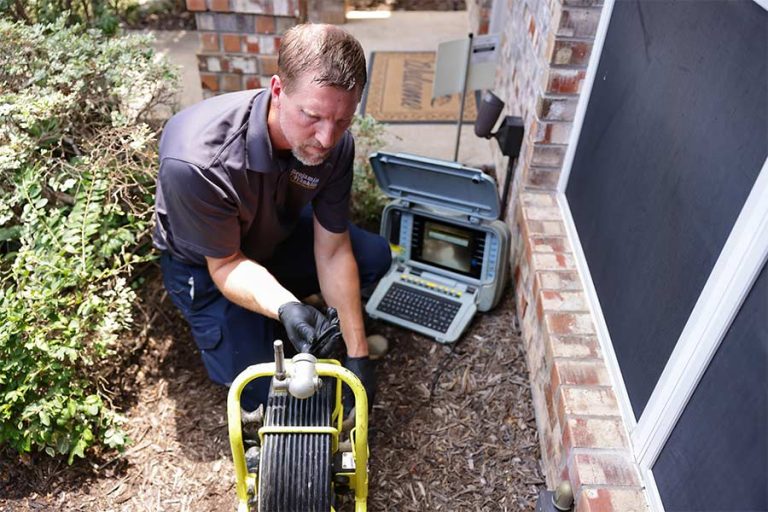
A sewer camera inspection sends a waterproof video camera through your sewer line so you can see the actual condition of the pipe instead of guessing at it. It identifies root intrusion, cracks, offsets, scale buildup, and collapsed sections, and it shows exactly where along the run each problem sits. It takes under an hour in most homes and requires no digging.
The reason to start here rather than start with a repair is straightforward. Every sewer decision, whether to clean, spot repair, line, or replace, depends on information that only a camera provides. Without it, you are buying a solution before diagnosing the problem.
Cedar Hill adds two local wrinkles. The city sits on the White Rock Escarpment, so elevation change across a single property is common, and sewer laterals here often run at steeper grades or greater depths than they would on flat ground. Cedar Hill also has substantial mature tree cover, particularly in the older neighborhoods near the state park and along the FM 1382 corridor, and roots are the most common cause of lateral failure we see. Both factors make visual inspection more valuable here, not less. Homeowners can review what plumbers serving Cedar Hill typically find on these lines before scheduling anything.
Why Do Cedar Hill Homeowners Need Sewer Camera Inspections?
The core value is that a camera converts an expensive guess into a known quantity. Sewer problems are invisible by nature, and the symptoms they produce, a slow drain, a gurgle, an occasional backup, all look alike from inside the house, regardless of whether the cause is a hairball or a separated joint eight feet down.
That ambiguity is where money gets wasted. A homeowner who repeatedly pays for cleanings on a line with a structural break is buying temporary relief at full price, several times over. A homeowner who authorizes a replacement on a line with a single clearable obstruction has bought a great deal more pipe than is needed.
There is a second use case that matters more in Cedar Hill than in most places. Before a home purchase, a camera inspection tells you whether you are inheriting a functioning sewer lateral or a five-figure problem, and standard home inspections do not include it. On older homes with mature trees over the lateral path, that single hour of video is among the most cost-effective due diligence available.
The third case is preventive. On a house with known root pressure, periodic inspection establishes a baseline and shows whether intrusion is progressing slowly or quickly, which lets you plan a replacement on your schedule rather than during a backup on a holiday weekend. Scheduling it alongside a full plumbing inspection covers the supply side at the same time.
How Do Sewer Camera Inspections Work?
A flexible, waterproof camera head on a semi-rigid push cable is fed into the sewer line through an existing access point, usually a cleanout near the foundation or at the property line. If no cleanout exists, access is sometimes made through a removed toilet.
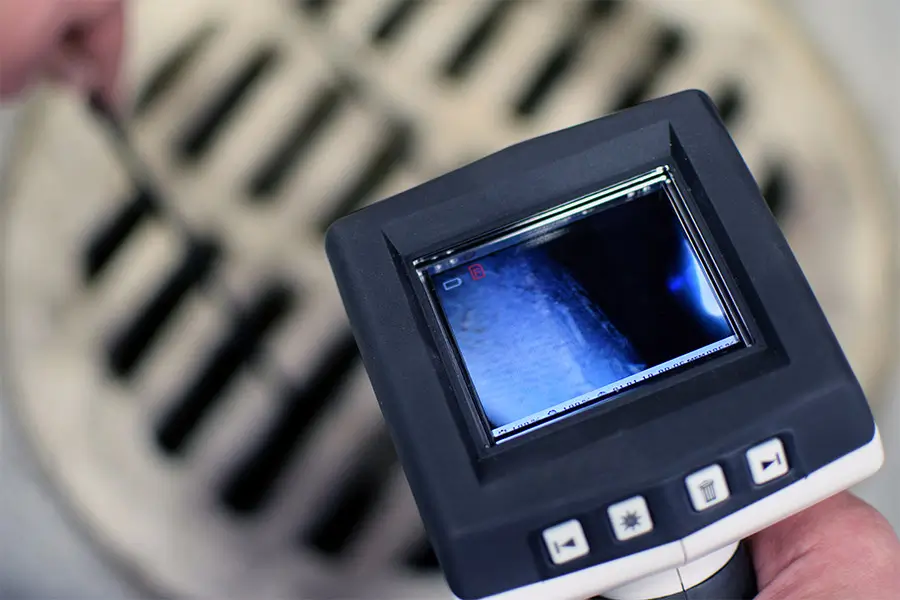
The camera transmits live video to a monitor as it travels. A light ring on the head illuminates the pipe interior, and a transmitter in the camera head allows its position to be located from above ground, which is what makes it possible to say a defect sits at 42 feet from the cleanout, under the driveway, rather than saying it sits somewhere in the line.
That distance readout is the part homeowners tend to underestimate. Knowing the depth and location of a problem is what allows a targeted repair rather than exploratory digging, and it is the difference between opening three feet of yard and opening thirty.
What a technician reads from the footage includes the pipe material, the joint condition, the presence and type of intrusion, whether the pipe holds its shape or has deformed, and whether there is standing water indicating a low spot or belly in the line. A belly matters because it collects solids and produces recurring blockages that cleaning will never permanently solve.
The footage is reviewed with you rather than summarized at you. If a plumber will not show you what the camera saw, that is worth questioning.
What Problems Do Sewer Camera Inspections Commonly Find?
Root intrusion leads the list, and in Cedar Hill, TX, it leads by a wide margin. Roots find joints and hairline cracks because those points release moisture, then expand inside the pipe until they form a net that catches everything moving through it. On clay laterals with joints every few feet, this is the expected failure mode rather than an unusual one.
Cracks and fractures come next, often as longitudinal cracking in cast iron or shattered sections in clay. These admit soil and groundwater and eventually lose structural shape.
Scale and mineral buildup narrow cast-iron lines from the inside. The pipe interior corrodes into a rough, tuberculated surface that both restricts diameter and catches solids, which is why an old cast iron line can back up repeatedly with no single identifiable blockage.
Grease accumulation is the most preventable finding, and it is concentrated in kitchen lines. It solidifies on cool pipe walls and builds in layers.
Offsets and separated joints show up where soil movement has shifted one pipe section relative to the next, leaving a ledge that catches solids. This is common in expansive clay soil and is more common on the sloped lots that Cedar Hill’s terrain produces.
Bellies, or sagging sections holding standing water, are the finding most often missed without a camera, because they produce recurring symptoms with no visible obstruction. Clearing the line brings temporary relief and the belly stays. For root-driven blockages specifically, professional rooter service clears the intrusion, but the camera is what tells you whether clearing will hold.
What Does Early Problem Detection Actually Save?
The savings come from three distinct places, and it helps to separate them.
The first is the method cost. Catching a defect while the pipe is still structurally sound keeps the trenchless options open. A line that has deteriorated past the point of supporting a liner, or collapsed to where no cable can pass, forces open-cut excavation and the restoration bill that comes with it.
The second is collateral damage. A sewer backup that reaches finished flooring becomes a remediation job on top of a plumbing job, and sewage contamination has a different and higher cleanup standard than clean water.
The third is scheduling. Emergency services carry emergency pricing, and emergencies do not wait for a convenient time. A problem identified in a routine inspection gets fixed on a planned date at a planned price.
There is a fourth benefit that is harder to quantify but real at the sale time. Documentation showing a sound sewer lateral, or showing a completed replacement remove a negotiating lever that buyers otherwise use. For lines that need work, trenchless sewer repair and replacement keep the yard and driveway largely intact, which matters when the house is going on the market.
How Do You Choose the Right Plumbing Service for Your Inspection?
Start with whether they will show you the footage. A camera inspection whose output is a verbal summary and a repair quote has given you the plumber’s conclusion, not the evidence. Ask for the video or a copy of it.
Second, ask whether the camera locates depth and distance. A camera that only produces pictures tells you something is wrong. A camera with a locator tells you where, and only the second one supports a targeted repair.
Third, look for upfront pricing rather than estimates that firm up later. Benjamin Franklin Plumbing & Drain Services of Duncanville prices the work before it begins and backs the on-time arrival with the “If there’s any delay, it’s you we pay” promise, which turns scheduling into a commitment rather than a window.
Fourth, consider whether the company can perform the resulting repair with more than one method. A contractor who only does open-cut excavation has a structural incentive to find open-cut problems.
Emergency availability is the last practical filter. Sewer backups happen at inconvenient times, and having a known number to call is worth something before you need it.
Frequently Asked Questions
How much does a sewer camera inspection cost in Cedar Hill, TX?
Pricing depends on access and line length, and Benjamin Franklin Plumbing & Drain Services of Duncanville quotes it before the work rather than after. The more useful way to think about the cost is against what it prevents: a single unnecessary cleaning cycle or one wrongly scoped repair generally exceeds the inspection.
How long does a sewer camera inspection take?
Under an hour for most residential lines with an accessible cleanout. Homes without a cleanout take longer because access has to be established first, which is worth knowing when you schedule.
Can a camera inspection be done if my line is currently backed up?
Usually, the line has to be cleared enough for the camera to travel and for the lens to see. Standing water and heavy debris obscure the view. The common sequence is to clear the line, then camera it to find out why it blocked in the first place, which is the step homeowners most often skip.
Do I need a camera inspection before buying a home in Cedar Hill?
On any older home, and particularly one with mature trees near the sewer path, it is among the highest-value inspections available and it is not part of a standard home inspection. The cost of finding out afterward is measured in thousands.
How often should a sewer line be inspected?
For a home with no history of problems, every few years is reasonable. For a home with a known root intrusion or an aging clay lateral, annual inspection tracks whether the situation is stable or progressing, which is what lets you plan the replacement instead of reacting to it.
Seeing Inside Your Cedar Hill Sewer Line Before You Spend
Every sewer repair decision rests on information about a pipe nobody can see, and a camera is the only tool that supplies it. Starting there means the money you spend goes toward the problem you actually have, at the scope it actually requires.
If your drains have slowed, you have had more than one backup, or you are buying an older Cedar Hill home with trees over the lateral, the sensible first move is an hour of video rather than a repair estimate. You can schedule your appointment today and make the next decision with the pipe in front of you.
